The Alphabet Soup of Bone Health
By Ann Constantino,
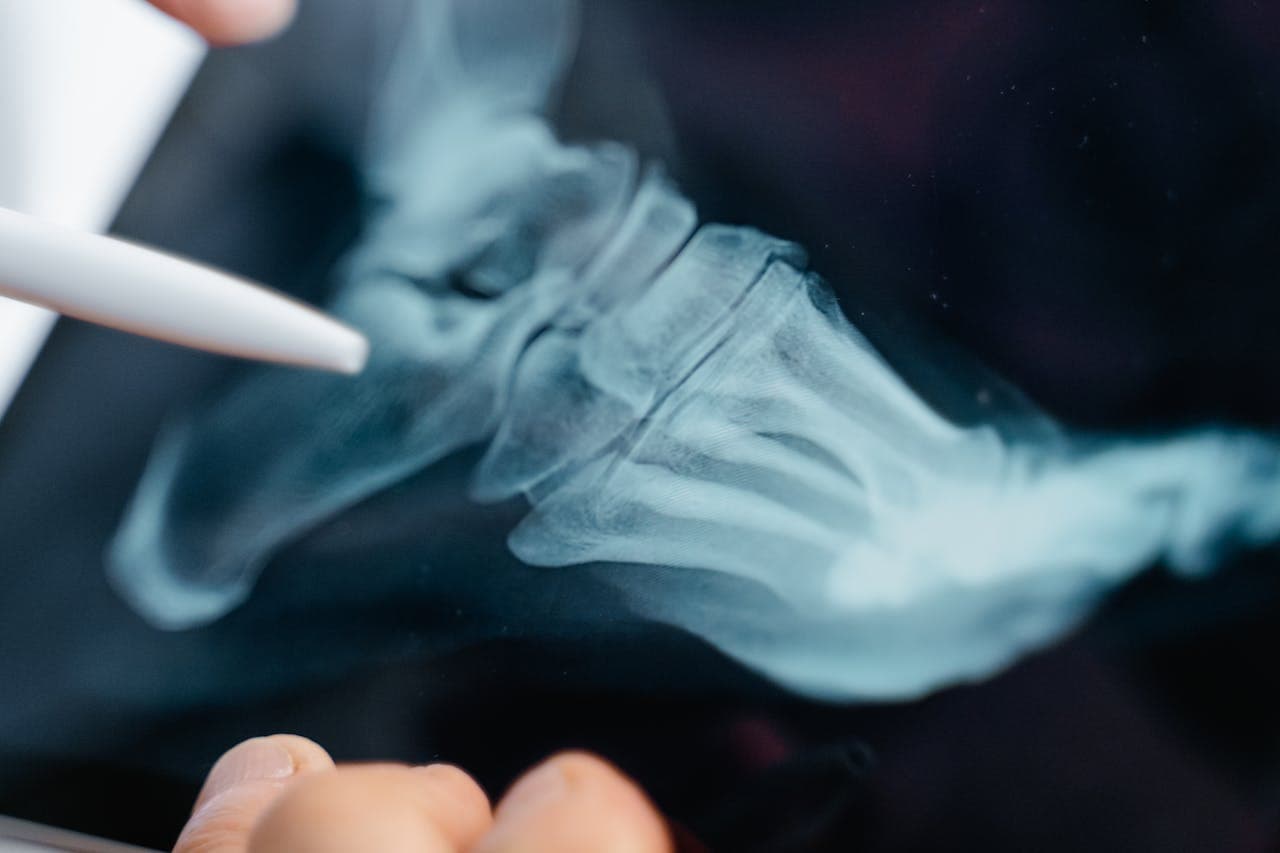
Photo by Tima Miroshnichenko.
Did you know that as many as 70% of age-related fractures occur in people who do not have osteoporosis? A 2019 study published in the Journal of Clinical Endocrinology and Metabolism looked at 3,700 people over age 50, and concluded that aging itself was more likely the cause of fractures than osteoporosis.
DEXA scan
The study used the well-known and most commonly used DEXA scan. DEXA is the abbreviation for Dual-Energy X-ray Absorptiometry, and by the late 1980’s it had replaced more primitive scan technology that began to be developed in the 1960’s. Nowadays, DEXA scans are recommended for all women over the age of 65 and all men over 70. In some cases, younger people are recommended to have a DEXA scan, such as when taking a medication that can deplete bone density or when a person’s history involves prior fractures, among other issues.
Now, a new method of measuring bone strength, as well as a growing body of evidence suggesting that fall prevention and strength-training exercises reduce the likelihood of debilitating fractures, are offering an improved outlook on healthy aging and bones.
Fragility fractures often lead to a severe deterioration of health for elders.
Bone loss can lead to what is known as a fragility fracture. This type of fracture happens when a bone breaks from a non-traumatic event, such as falling from standing height, that would not normally break a bone. Fragility fractures often lead to a severe deterioration of health for elders. Death occurs within 12 months in as many as 30% of those who have suffered a fragility fracture of the hip or spine.
Results of a DEXA scan that measure bone mineral density (BMD) are called the T-score and are usually taken at the hip (femoral neck) and the lower spine (lumbar vertebrae), and sometimes the wrists. Your T-score in each area measured will put the BMD of that area into one of 3 categories: normal–as would be seen in an average 30-year old; osteopenia–below normal, but not yet at high risk of fracture; and osteoporosis–well below normal and associated with high risk.
Poor T-scores have led to millions of patients being prescribed pharmaceuticals to stop bone loss or even build new bone. The global market for these drugs was valued at $15 billion in 2024 and is expected to rise alongside an aging population to as much as $22 billion by 2030.
The controversy around bone loss drugs
The drugs are controversial not only because of their unpleasant side effects and high cost to the consumer, but more importantly, because bisphosphonates, one of the most commonly prescribed of several classes of fracture prevention drugs, can ironically lead to increased brittleness of bone when used long-term. Prolonged use can also lead to fractures occurring through everyday activities rather than through minor falls, as well as to the rotting of the jawbone. Doctors have taken to recommending a “drug holiday” from bisphosphonates to those patients using them for more than 3-5 years, with further controversy surrounding the decision to resume taking them.
Consumer groups also warn that the powerful pharmaceuticals are often over-prescribed for those with T-scores in the osteopenia range, an unnecessary expense as well as the risk of dangerous side effects.
Dr. Michael Yeh, associate professor of surgery and medicine at UCLA, participated in a study published by UCLA Health a decade ago that showed that bisphosphonate bone loss drugs make bone look denser and stronger in an X-ray, but that is deceptive. The drugs reduce resorption (loss) of bone but do not replace it with anything, leaving behind brittle bone. As with all living tissue, bone is continuously broken down and replaced with new material, preserving its vital strength throughout our lifespan. It is the age-related slowing down of replacement that results in osteoporosis being a natural part of aging.
REMS
REMS has the additional advantages of being radiation-free.
Enter REMS: Radiofrequency Echographic Multi Spectrometry. REMS was developed in 2018 by the Italian company Echolight. This newer scan shows promise as a superior way to measure not just bone density, but also other aspects of bone quality. REMS has the additional advantages of being radiation-free, using ultrasound technology to measure bone quality; plus it is quicker, taking only a few minutes to perform; and it can be repeated more frequently if a patient’s individual case necessitates more than the typical every-other-year schedule for DEXA.
Approved by the FDA, and covered by Medicare and some insurance carriers for those not yet of Medicare age, REMS has the advantage of rendering not only a BMD T-score, but also a new measurement, called the “fragility score” (FS). The FS ranges from 0-100, with 100 being the highest risk of fracture, looking at features of bone other than simple density, as in the case of the DEXA scan. To obtain the FS, REMS measures the micro-architecture of bone, identifying weaknesses DEXA cannot. The more nuanced scan also eliminates the interference caused by a patient’s arthritis, making bone density appear better than it actually is in the spine when arthritic features such as bone spurs and disc space narrowing are present.
According to the National Institutes of Health, the FS provided by REMS makes it a better predictor of a fragility fracture than DEXA, and therefore a superior tool at determining risk. However, change comes slowly to the medical establishment, and many doctors are not yet familiar with REMS. Use of REMS is growing a bit more rapidly in Europe, where many studies have shown its accuracy and advantages.
Not yet available in Humboldt, there are several facilities in the Bay Area that offer the REMS scan.
If you are at risk of fracture, whatever your age, non-pharmaceutical remedies go a long way toward reducing that risk and have nothing but beneficial side effects. Balance training is effective for fall prevention, and resistance training stimulates bone growth while also reversing age-related muscle loss.
Work with your provider to create a strategy to address your bony concerns.
Ann Constantino, submitted on behalf of the SoHum Health’s Outreach department.